|
Thud Thai:
Flying Low,
Fast & Deadly
Skip Holm Remembers Flying the F-105
By: Mark Huber
|
|
 |
Republic
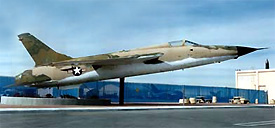
F-105 Thunderchiefs flew more combat missions over North
Vietnam than any other aircraft. Almost 60 percent of the 600
“Thud” fighter-bombers flown in the Vietnam War were lost. Not
since B-17s flew unescorted against World War II Germany had
American aviators been caught in this kind of carnage.
Skip Holm flew 105s in Southeast Asia and survived.
Holm is a thin and plain spoken North Dakotan. His mischievous
smile is fueled by a passion for pranks. He is the misbehaving
cartoon kid Dennis the Menace in a flight suit.
Holm holds the record for most
combat hours flown by any fighter pilot in the U.S. Air Force;
1,171. All were during Vietnam and almost half were in F-105s.
At 60, he remains one of the world’s foremost test pilots. He
also is champion air racer, air show performer, and movie
stunt pilot. During three tours in Southeast Asia he won
three Distinguished Flying Crosses, 25 Air Medals, and
numerous commendations. Flying 163 missions in 1968 and 1969
from bases in Korat and Takhli, Thailand, Holm logged 471
combat hours in F-105s. (The rest of his combat time would
come later in the war flying F-4s.) The Thud is one of his
favorite fighters out of the dozens he has flown.
Calling the
Thud a fighter is really a misnomer. It was big: It stood
twenty feet tall and fully loaded weighed 40,000 pounds. One
could walk under the wing without stooping. If a pilot tried
to get out of the cockpit without a ladder he was going to
break bones.
While it was
equipped with a 20 millimeter Gattling canon and air-to-air
missiles, the Thud was an undistinguished dogfighter. There
was no rearward visibility from the cockpit. Its high speeds
and small, 45 degree swept wings gave it a huge turning
radius.
In combat,
pilots were told to engage the enemy head-on or outrun him.
Because of its high stall speed, the minimum airspeed required
for the wings to produce lift, takeoffs and landings in Thuds
were never routine. With a full 6,000-pound bomb load, Thuds
didn’t lift off until they hit 250 knots, 288 miles-per-hour,
and easily used almost 9,000 feet of runway to get airborne.
Engaging the
fuel-sucking, flame-spitting afterburner wasn’t something you
did occasionally in a Thud for momentary extra power, like it
is in most other fighters: It was a way of life.
Built by Republic Aircraft on Long Island, the single-engine
F-105 was designed in 1951 during the Cold War. Mission: Take
off from NATO bases and fly low and fast, 200 feet and 800
knots, and drop a tactical nuclear weapon on a member of the
Warsaw Pact. By the early 1960s, it was a task rendered
largely obsolete by ballistic nuclear missiles. However, a new
mission for Thuds awaited in Vietnam.
Holm began
his 105 training at McConnell AFB, Kansas in November 1967
under the tutelage of the notorious squadron commander, Lt.
Col. Jim “Black Matt” Matthews. Black Matt had flown as a
member of the Air Force’s demonstration team, the
Thunderbirds. He is better known for making a supersonic pass
in a 105 over U.S. Air Force Academy on May 31, 1968, breaking
more than 300 large dorm and dining hall windows.
Holm
was an impressionable second lieutenant. To this day he calls
Matt one of his personal heroes.
Matt prepared
the squadron for battle with a militarized version of
fraternity hazing coupled with old salt combat wisdom. As
training ended in May 1968, Holm flew a simulated combat
sortie with a gaggle of 37 other airplanes from Thailand to
Hanoi, using the route between McConnell and George Air Force
Base in California. In route, F-100s pretended to be attacking
MiGs and mock anti-aircraft artillery (triple A) fire shot up
from Western slopes of the Colorado Rockies.
The “target”
was in the desert on the California-Nevada border. Senior
squadron leaders led the strike that dropped live bombs. The
phone began to ring at George. They had bombed the Last Chance
gas station by mistake.
Actually,
they bombed near it. They were aiming for it, but missed.
In
retrospect, Holm realized this was a perfect primer for
Vietnam. “You had a bunch of airplanes flying against one
target, and you missed.” He was on his way to Thailand.
On June 20,
1968, Holm piled into the back of a C-130 cargo plane headed
out of Bangkok for the 388th Tactical Fighter Wing
based at Korat, 100 miles to the North.
Holm and Air
Force Reserve pilot Robert John Zukowski, 23, a buddy with
whom he had done all his flight training in the States, were
immediately assigned a room in a hooch, a clapboard hut with
eight very small bedrooms, two men to a room. The bedrooms
shared a common, bug netted porch with a beat up TV and a
refrigerator. The hooches were built on dirt and leaked
spectacularly during daily thunderstorms.
Showers and
latrines were outdoors. During one of his first showers at
Korat, Holm felt a woman’s hands washing his legs. It was the
hooch maid, typically an older Thai woman unofficially
assigned to each hooch to clean and do laundry. “She wasn’t
exactly exciting,” Holm says.
There were no
sidewalks or paved roads. Nobody walked. They rode on benches
in the back of dirty pickup trucks.
Dress was
casual. Pilots wore unkept fatigues, flight suits, and
Australian Akubra hats. They passed the time shooting geckos
off hooch walls with blow guns, fashioning pyramid investment
schemes, and watching Armed Forces TV. There was no
basketball, baseball, ping-pong, or billiards. Drinking was
the only organized recreation.
“We did most
of our drinking and took all our meals in the officer’s club.
The O club would crank up at 9 or 10 at night and getting out
of there was a real problem. You had to sneak out the door.
And there was no telling when your roommate was getting back,”
says Holm. Or his condition on arrival.
“Carrier
landings” were a mainstay of squadron parties. Tables were
pushed together and covered in plastic sheets. Water was
sprayed on the plastic and lights flashed on and off to
simulate lightening. Pilots would come in for a single ship
landing on this “runway” by dashing toward it, jumping up, and
sliding down the plastic on their bellies. While they were
doing this they had to curl their legs to catch the arresting
“wire,” a piece of rope held by two guys who raised or lowered
it depending on their opinion of the pilot.
But one
didn’t want to miss the rope, for at runway’s end awaited a
very muddy pit holding a live, squealing pig.
Runway
overshoots sent Holm and 14 others to the medical lab for
stitches one night. They were sewn up without Novacaine
because they had to fly in a few hours.
Parties
helped relieve the stress and there was a lot of it, because
105 pilots in Southeast Asia faced lousy odds.
Flying 105s
then was very different than the precision-guided bombing
missions of today. By contemporary standards, Thuds were
ill-mannered and dangerous. “To this day the only
air-to-ground attack aircraft that even approaches the 105’s
speed is the Russian Su-27,” says Holm.
Laden with
bombs and fuel, the 105 could climb no higher than 15,000
feet. The cockpit was unpressurized. The small wings loaded up
Gs and pilots would gray out or black out in tight pulls after
dropping bombs.
The
hydraulics, avionics and navigation systems on the 105 were
unreliable. Early 105s required an average of 150 hours of
ground maintenance for each flight hour. The TACAN navigation
receiver would cut out when pilots dropped the landing gear.
To help Thuds find targets, a Forward Air Controller (FAC) in
a scout plane would hold down his microphone button and 105
pilots would key in on him using DF Reckoning, a 1930’s homing
technology.
Holm
frequently flew 105s in thunderstorms, through heavily
defended mountainous terrain, and against an enemy that
usually knew where he was going and when.
Given the 105
pilots’ appalling 75 percent survival rate, discipline within
the ranks was sometimes a problem. The common retort to an
unwanted order was, “What else can they do to me? Make me fly
105s in Southeast Asia?”
This fatalism
started Holm’s smoking. “Nobody thought about lung cancer. You
weren’t going to live long enough to get it.” Alone in his
hooch, on the third day of Holm’s smoking career he fell
asleep, butt-in-hand, and burned it down. “I stopped smoking
then and there.”
Holm resisted
duties not related to flying. “I just flat-out refused. I was
there to fly—period.” he says. “Finally, a colonel insisted
that I help the flight surgeon with ‘VD Patrol.’ I was
supposed to go into town and inspect the girls, and hand out
color-coded stickers. White ones to safe girls and brown ones
to those who weren’t.” As a member of VD Patrol, Holm got a
jeep and painted the fenders pink. He would line up the girls,
hand out stickers, and ask which girls wanted to work that
night. “If they had a brown sticker we told them to trade
with a girl with a white one.” His methods were discovered
and after only a week he was relieved from VD Patrol and
forced to return the jeep.
“I wasn’t
much good at drinking or smoking. I failed at my one extra
duty assignment. I just wanted to fly,” says Holm. Despite its
shortcomings, Holm loved flying the 105. “It was very stable,
a Cadillac of a fighter. It flew great in formation.”
He loved the
airplane, but not the hours. Although raised on a farm, Holm
disliked the 2AM wake up calls. Mission briefings often began
at 3AM. Sometimes 4. There were no alarm clocks. A siren would
go off when it was time to get up. Another helpful hint for
the Vietcong watching us Holm thought.
Some guys
would stay at the O Club too late. They would have to be
dragged to briefings and actually put in their airplanes.
Doped by the flight surgeon’s amphetamines and combat
adrenaline, most flew well anyway.
Roscoe the
dog was the briefing’s barometer. Named for Korat’s TACAN
navigation fix, the adopted stray resembled a coyote. It was a
bad omen if he was antsy or stood next to a pilot at the
briefing. Guys Roscoe stood next to had a bad habit of not
coming back. However, if Roscoe slept through the briefing
usually things would be okay.
A big map
tacked to the wall indicated routes and targets. Forget
whizbang audio-visual, this was the Twelve O’Clock High
chalkboard. Little homemade maps marked with grease pencil
were the on-board navigation display.
Pilots tuned
into certain things at the briefings, like bombing and tanker
routes, and tuned out anything to do with search and rescue.
It was almost
irrelevant. Bodies ejected at 600 miles an hour were mauled by
friction from the oncoming air: Legs, hips, spines, and necks
were snapped. If he survived, the pilot probably couldn’t
walk. Where he landed was heavily defended and a “Jolly Green”
rescue helicopter going in there was easy prey. When a 105
crashed it meant search and rescue was going to lose airplanes
and men trying to recover a pilot who likely could not be
saved.
Briefing
over, pilots ate around 4 and got in their airplanes at 5.
The contents
of the free bottle of booze given to a pilot the night before
each mission often found its way onto the airplane.
Behind the
ejection seat, 105s had a small gallon water tank connected to
a hose pilots could drink through. Crew chiefs would put
whatever the pilots wanted in those tanks: not just water but
gin and tonics, rum and cokes, Bloody Marys, anything.
The tank was
intended to provide hydration on long missions or after
shutting down the air conditioner on bombing runs. The air
conditioner was powered by a small ram air turbine that spun
in the wind beneath the cockpit floor. If the turbine got hit
by small arms fire while turning at 28,000 rpms it was like a
bomb going off under a pilot’s feet. It would cripple the
airplane. So pilots turned it off over threat areas. And the
cockpit got hot.
After
breakfast, pickup trucks shuttled pilots to the revetments
sheltering their airplanes. Thuds were kept in revetments so
if an airplane blew up it, the blast would not impact others
parked nearby.
This thing
might blow up when I start it,
thought Holm.
Pilots could
not see adjacent airplanes so starts were synchronized on the
clock, rather than by using hand signals.
The 105 was
started on a cart and primed with a series of simultaneously
firing shotgun shells. It created giant plumes of gunpowder
smoke that permeated the cockpits.
Pilots then
pulled into the arming area. Crew chiefs would take the pins
out of the weapons. The local chaplain would bless each flight
and then walk ahead of it, holding up both hands with his
index and pinky fingers extended, like the sign language
symbol for peace.
Takeoffs
began at 5:30 and lasted an hour.
A 105 pilot
would run up his turbojet engine to full military power or
17,000 pounds of thrust, hold the brakes, put the airplane in
afterburner, and push the throttle outboard. The minute he
felt the fuel nozzles open up he took his feet off the brakes.
Instantly the afterburner lit up and banged. Then the water
injection system came on.
Loaded with
6,000 pounds of bombs, 1,200 rounds of 20mm ammunition, and
fuel, the single engine 105 struggled to escape the ground.
The
alcohol-water injection system generated more takeoff power by
artificially increasing the density of the air going into the
engine, making the air thicker as it passed through the motor
and blowing more thrust out the back end. “If you didn’t get
an immediate rise in exhaust gas temperature after turning on
the water, you had to abort,” said Holm.
More high
drama lay ahead. As a pilot lifts off precariously close to
the end of the runway, he retracts the landing gear. The nose
wheel swings forward, increasing drag as it folds. A knot or
two of airspeed bleeds off as a result and then the airplane
sinks down toward the runway. The speed brake or the tailpipe
drags on the pavement. Sparks start to fly. The crew chiefs
sit at the end of the runway and watch, cursing the pilot for
messing up “their” airplane.
They
were not alone. The Vietcong were there too, just beyond the
fence. Shooting at Thuds with rifles. Counting airplanes and
bombs. Noting the direction of flight and calling it into
Hanoi. They knew where the 105s going, maybe even knew the
names of targets. They knew because 105s did not have decoders
on their UHF radios. It was an open channel. Anybody with a
frequency analyzer could hear it and frequencies rarely
changed.
Sometimes it
was just too hot to get a Thud off the runway. But when a 105
launched, it was an exhilarating ride. Climb out was at 450
knots. The leading edge wing slats stayed out until 500. The
wing flaps stayed down until 560. Going so fast that the nose
cone on 12.5 mm rocket pods slung under the wings would
sometimes fly apart, creating so much drag that the only
rational option was to jettison the entire pod.
The
afterburner comes off at 15,000 feet and there’s the aerial
refueling tanker, a militarized version of a Boeing 707
airliner. Bad things can happen on the tanker. Occasionally a
guy would “arm up,” flip a switch to remove the safeties on
his bombs, while on the tanker. Distracted by refueling, he
would hit the wrong switch and accidentally jettison his
bombs. “You would hear an ‘oh-oh’ on the radio, look over, and
see the bombs falling away,” says Holm. And no one would say
a thing. Because if they did it meant a demolitions team had
to go looking for those bombs.
It could get worse. “One time a
guy pulled up to the tanker and his whole airplane just
exploded,” says Holm. “His bombs had proximity fuses and the
tanker set them off.”
By the time a
pilot pulls up to the tanker on that first mission, the worst
of his anxiety is probably over. He may have trained in a 105
in the States but the one he picks up in Thailand is nothing
like it. It is beat up and tired. On the first few missions he
is getting someone else’s airplane, someone else’s crew chief.
He hasn’t flown since he was in the States a month ago. He
worries about getting lost in the revetments on the taxi out.
Sweats about breaking off a landing gear on the caved in
taxiway. It’s hot out and the plane is heavy. Will it make
enough power? If he aborts takeoff late will he go off the
end of the runway?
So now he
calmly drops off the tank and flies to the FEBA, the forward
edge of the battle area. “When I turned the air conditioning
off and got a whiff of that country air it always seemed to
calm me down a little bit,” says Holm.
Most of the
time a Forward Air Controller or FAC would be waiting for the
Thuds near the target in an F-100 “Misty” Fast FAC or an A-1
Skyraider, a modified World War II piston engine fighter.
The FAC would mark the target with a phosphorous rocket that
also alerted enemy gunners to incoming Thuds.
At this point, any remaining pilot anxiety gives way to pure
confusion. “During your first ten sorties you really have no
idea what you are doing,” says Holm. The triple A would come
up from the ground like little sparkles. Lead will put the new
guy in the #2 slot so he can keep an eye on him.
When #1 and
#2 roll in on the target they were usually safe. The guys in
#3 and #4 would take the hits as enemy gunners became more
proficient.
Coming off
the first few missions a new Thud pilot was just trying to
stay with Lead. Everything is baffling and very little is
remembered afterward. Holm explains, “On one of my first
missions I strafed a gunner shooting at Numbers Three and
Four. We bombed the target and then hit a bunch of oil drums
along the road. It was a great mission and I remembered almost
none of it.” So rookies don’t say much during post-mission
debriefs. They don’t know where they were or what they did in
great detail.
After hitting
the target it’s back to the tanker and then free roaming like
a wolf pack back to Korat, getting more targets from the
Seventh Air Force, the FAC, or hitting targets of opportunity;
checking out the roads below for suspicious activity. Two
favorite targets were water buffaloes and floating junks on
the South China Sea, both common ways for the North Vietnamese
and Vietcong to transport war materiel.
“I really
remember the boats,” says Holm. “You would roll in on them
and watch the crews jump into the water right before you blew
their boat away.”
Strafing
trucks was trickier. Since there was no clear way to
distinguish the North Vietnam-South Vietnam border from the
air, a pilot had to take great care not to dispense friendly
fire. Strafing enemy guns was frowned on, but everybody did
it, and the loss rates from it were hellacious.
Then there
was the satisfaction of plain old harassment. “Some guys
wanted to go supersonic across North Vietnam just to break
some glass,” says Holm. Part of the Thuds’ mission was simply
making noise to keep the Vietcong awake as they did most of
their work, running men and guns to the South, at night.
The formation
would be flying low when looking for these secondary targets,
using an evasive maneuver to avoid enemy fire called jinking.
A flight of four would cut back and forth at overlapping
intervals to protect each other. Two guys always watching the
other two guys. It sort of looked like a DNA helix. One and
Two were down low while Three and Four flew cover above.
Everyone was always at 180 degrees from someone else.
Targets hit,
there was a natural tendency to blow off steam flying back to
base. Holm describes the feeling. “You just came out of a
combat area. You are pretty psyched up. The adrenaline is
high. The airplane is still working good. You have fuel. It’s
a nice sunny day and you don’t have to shoot an (instrument)
approach. Basically, the mission is over.”
And there
straight out the windshield is the lovely South China Sea or a
lake.
The formation
rolls around the clouds. Then everybody gets down low over
water, hits the afterburners, and fans out. Who is going to
chicken out first? Airspeed is 500 knots and everyone is still
headed down. Then someone’s 650-gallon centerline auxiliary
fuel tank hits the water. He hears it. He feels it. And he
grabs the stick and pulls hard. Before anyone can blink the
“bouncer” has climbed 500 feet. “Once I saw a guy hit the
water completely flat at 800 knots and the force just threw
him back into the air,” says Holm.
Whoever hit
the water got the lead and the other three ships would join up
and check him over for damage. He’s OK and so everyone
lands—hot. If the drag chute doesn’t pop right away the Thud
is going off the end of the runway and the brakes will burn up
in the process.
Pilots had to
fly 100 combat missions before they could get out. Treks over
Laos and Cambodia didn’t count, so most completed 140 to 150
missions before they could go home.
The most
dangerous were the first ten and the last ten. “The first ten
because you knew nothing,” says Holm. “And the last ten
because you thought you knew everything” and became over
confident. For those who made it through their first ten
missions, things clicked fast.
Holm had only
been in country a few weeks when he took out his first big
target, a fjord over the Mekong. He nailed it with an AGM-20,
a 2,000-pound rocket-propelled bomb. Holm fired it at a
fairly flat angle because of a low cloud ceiling and the need
to guide the bomb with a joystick in the plane for as much as
five miles until it impacted. He had to throttle back to
ensure his Thud wouldn’t overrun the bomb and drive a straight
line through small arms fire and triple A all the way to
target. Target destroyed, he turned around and strafed the
triple A site, “Just like they told us not to.”
Holm had many
memorable F-105 missions but flew his favorite on Easter
Sunday 1969. “I fired an AGM through the front door of a
Pagoda that was filled with enemy ammunition. Blew the roof
off. Got some great pictures and sent one home to Dad. I
signed it, ‘Happy Easter.’”
Holm usually
flew 20 missions back-to-back and then took a few days off.
For “fun,” he visited other bases and rode in bombers or FAC
planes as an observer. While riding on a night mission in an
A-26 Invader, one of the two engines on the World War II
medium bomber caught fire. Then it suffered a complete
electrical failure. Flying right seat in a small O-2 Slow FAC
plane, Holm saw a 105 come apart in his windshield. The pilot
ejected, but the O-2 nearly clipped him on the way down.
When he
wanted a tamer diversion, Holm grabbed Zukowski and called a
cabbie they knew who voluntarily sat in back while they drove
like banshees down the freeway at 100 miles-per-hour to Patio
Beach or Bangkok. Patio Beach looked like Tahiti. Many U.S.
service personnel went there for R&R. On one trip to Bangkok,
Zukowski met a South Vietnamese nurse. They got married on
February 8, 1969. Three days later he was lost over Laos.
“To this day,
I don’t remember if I made any friends in Thailand other than
Zukowski,” says Holm. “Part of it was that after he got shot
down I didn’t care if I knew any of them anymore.”
Holm says he
didn’t think about it much at the time, he just focused on
flying his airplane. “I had more loyalty to the airplane than
to the people in the squadron. You gotta pick something to
trust in combat. I couldn’t trust that people would still be
there. So I trusted that the airplane would always work. And
it did.”
The squadron
threw him a nice party when he had his official “100” combat
missions. As he taxied in they greeted Holm with a procession.
All those pickup trucks with benches in the back. Fire
engines. Government vehicles. Basically anything with wheels
on it. There were sirens and American flags and Roscoe the
dog. They blew off canisters of smoke grenades and fire
extinguishers. They walked Holm from the airplane and soaked
him with water balloons and a fire hose.
The Air Force
began pulling F-105s out of Vietnam in 1969. Air Force Reserve
and Air National Guard units flew surviving aircraft until
1984. While several are in museums, not a single F-105 remains
in flying condition today.
Major Robert
Zukowski’s remains were recovered in 1996. He is buried in
Resurrection Cemetery in Justice, Ill., just south of Chicago.
A few years ago Holm went to Washington and found his friend’s
name on the Vietnam Veterans Memorial, Panel 32W, Row 18.
Time and emotional self-defense have blotted some of Skip
Holm’s F-105 experience from memory. He still remembers flying
low and fast and loving it. |





